Friday, August 24, 2018

Scrutiny Assessment under GST


The CGST Act, 2017 numerates various kinds of assessment.  They are:-

1. Self - assessment (Sec 59)
2. Provisional assessment (Sec 60)
3. Scrutiny assessment (Sec 61)
4. Best Judgements - in this there are two types of assessements -
    a. Assessment of non filers of return  (Sec 62)
    b. Assessment of Unregistered Persons (Sec 63)
5. Summary assessment (Sec 64)

I will hereby discuss the case of Scrutiny Assessment which is covered under section 61. 

Sub section 1 of section 61 states that - 
  • the proper officer may scrutinise;
  • the return and related particulars furnished by the registered person;
  • to verify the correctness of the return;
  • and inform him of the discrepancies noticed, if any;
  • and seek explanation thereto.

Comments - The adjudicating officer can open scrutiny return based on the particulars submitted by the registered taxpayer in his return.  If he finds any discrepancy apparent from the record, he can seek explanation from the taxpayer. However, at this stage the officer cannot demand for any books of accounts or details which are not directly related to his query.  

Since the officer can seek explanation based on any discrepancy, it becomes important to understand what could all be covered under "discrepancy"? In my opinion, some of the discrepancy could be:

  • any mathematical error;
  • any human error such as entry in wrong table or column;
  • huge difference between tax liabilities of various months;
  • Difference between ITC Claimed with the figures appearing in GSTR 2A;
  • Difference between turnover declared in GSTR 3B with those filed in GSTR 1;
  • Pending unpaid liability 
The Adjudicating officer will thereafter seek explanation from the taxpayer. The explanation at this stage would only be limited to the discrepancy observed.For example, in case there is difference between the turnover figures of GSTR 3B with those of GSTR 1 for the same tax period, the explanation in this case would constitute only reconciliation of sales figures for the tax period under consideration. 

Based on the explanation. the adjudicating officer can accept or reject the application. If he accepts the explanation, no further action shall be taken in this regard and the registered person would be informed accordingly. (Subsection 2 of section 61)

However, if 
  • no explanation is offered; or
  • the adjudicating officer do not find the explanation satisfactory; 
  • within a period of 30 days from the date of communication of such discrepancy or any such further period as may be permitted by him ( the time period to seek explanation cannot be less than 30 days); or
  • where the registered person, after accepting the discrepancies;
  • failed to take the corrective measure;
  • in his return for the month in which the discrepancy is accepted ( and not the month in which the discrepancy is found by the Adjudicating Officer or for the month for which discrepancy is observed);
the officer may initiate appropriate action, including
  • Audit u/s 65
  • Special Audit u/s 66
  • Inspection, Search & Seizure u/s 67
  • Demand notice u/s 73
  • Demand notice u/s 74                                       (Subsection 3 of section 61)
Comments - The proper officer may reject the explanation offered by the registered person and may initiate the proceedings as stated above.  The law does not state that the officer would pass an order before initiating the above proceedings. 

The law states that the registered taxpayer need to correct the discrepancy in the month in which he has  accepted the discrepancy. For example, if the officer finds a mismatch in data for the month of April 2018 in the month of August 2018, and informs the registered taxpayer accordingly. If the taxpayer accepts the discrepancy in the month of September, then he need to correct the discrepancy when he files the return for September, which, if he has opted for monthly return filing, would be 10th/20th October.

It may be noted that nowhere in the entire section a time limit has been set for issue of scrutiny notice.  Few authors are of the opinion that the time limit for issue of scrutiny notice would be the maximum time period of the consequences that flows out of section 61, which is under section 74. Section 74(10), states that a demand can be raised within a period of 5 years from the due date of furnishing annual return for the financial year to which the tax paid or short paid or input tax credit wrongly availed or utilised relates to, thus a scrutiny notice can be issued for a period of 5 years.  In absence of clear timeline, this provision is susceptible to legal scrutiny.

Thank You


Monday, May 14, 2018

A Great Saturday!


It was a usual saturday, as always, a lazy one. Getting up late, enjoying tea time with my father in law (that's my favorite time), stretching, yawning time & again. Since my daughter's summer vacations has been declared, so there was no rush to wake her up & finish up household stuff. No school, no office either for me or my husband! AAh! what a day it was. I desperately wait for weekends coz I get to read newspaper, which due to my strict schedule I am not able to do it regularly. After having a heavy breakfast, suddenly came an idea to go for a movie. The choice was not difficult as we have watched Raazi a day before. The next awesome movie released this week was 102 not out. So without any further delay I quickly booked 3 tickets for it. Thanks to BMS, it just happened in 2 min. The movie show was at 12:40pm and it was already 12:05 pm. So we literally had just 15 min to get ready & reach the theatres. 15 min, with kid! Suddenly mere ander ki hindustani aurat jaag gyi and there I was, ready with bag & baggage in just 10 min! I pat my back for such impossible achievements! I mean just think getting your child to understand that you are going in another 15 min (they look like kuch bhi ho jaye, hum to nhi ready honge!), changing their diapers ( bacchon ko right time motion ate hain, just when you are in utmost hurry), dressing them, combing their hairs ( this part is like a cat fight), and getting ready yourself. I generally don't go for make ups except the basic ones but deciding a dress is such a task! Adhe ghante to bas isi ke liye chahiye! Finally we all threw ourselves in the car and rushed to the theatre. Aaj tak to Lucknow main koi movie time se start nhi hui, but that day it was bang on time! We were late by 5 min and missed the initial part. Chalo koi nhi, quickly we got ourselves settled and watched an awesome performance by Amitabh Bacchan & Rishi Kapoor. After the movie we did some shopping and returned back home. It was 3 :15 by that time. In my mind a clock was ticking. Today I had to go for Linkedin Local connect at 4:30pm. While serving the lunch a lot many questions were going through my mind. What it would be like, another networking event? Lots of formalities, bhashan baazi and all that stuffs or would it be different? I had attended another networking event & I tell you it was damn boring! So I was bit skeptical. But, then I moved out to get there. Played my FM and Vroom!
I reached my destination in time. Met few participants on the entry gate, few on the lift and as soon as the lift door opened at the area, whoo..so many people were already there. It was a book cafe area, a nice one. The ambience itself lifted the mood that this is not going to be a formal event. I started interacting with people there, and many of them recognised me, thanks to the whatsapp photo introduction a day before on our whatsapp group. Everyone met with smile & excitement! There were all sorts of people, young & old, from diverse backgrounds, IT, HR, Entrepreneurs, Lawyers, start ups, doctors, a CA myself, exporters, Importers, education and what not. People with such diverse backgrounds, who after working for many years in corporate world, left their job, and came back to Lucknow, their hometown to pursue their dream. After the initial tea session, the organisers asked us to introduce ourselves to other people in 30 sec.  I just couldn't believe such crowd exists in Lucknow. I always thought it was a place of traditional businesses where people prefer to work in traditional way. Chalta hai attitude to zabardast hai yhan. Aise main ye log khan chupe baithe the? Perhaps everyone there must be thinking the same. Intro session was in mid way when the special invitee, the star guest, Mr. Jayant Krishna came. Dressed very smartly, he had a smiling face. Very politely, without making any noise, and without throwing any tantrums, he asked the organisers to continue with the intro part and that he would like to be addressed later. That's called simplicity! After we finished, he was introduced. We all looked at him in awe! Such a big achiever he was. I wondered how did organisers got his time? How did they persuaded him to attend this event? I mean, why a man of his stature would like to devote his weekend time with us, so new people? Later he told us the secret that one of the organiser was his wife's friend and that he do not want to upset his wife ( haha)! Jokes apart, I am really thankful to him for sparing his so much precious time. Then came Q&A session. Everyone put forth so relevant questions to him & the ease with which he answered them speaks volume about his experience. During one of the questions he said, one day, after I retire, I want to do for my city, my Lucknow. And my heart bleeded, as if somebody has touched a very sensitive chord.
I am not born & brought up in Lucknow. My father had been in government job so we have been moving across the state due to his postings. But I completed my CA & LL.B.(H). from here. There is altogether a different kind of attachment with this city. I also want to do something for my city, I want Lucknow to grow.  I have met people in different states who belong to UP but they have to leave their city coz of lack of opportunities. And everyone wants to return. Who wants to leave their aged parents alone? But none of our governments have worked so far on this front. I have a lot of expectations from current government, both Central & State and hopefully they understand our plight! We have everything except a strong political will. 
Anyways, the session ended. My spirits were all high! Its not that I will get some business from there but the kind of satisfaction you get when you mingle with like minded people is a different experience altogether.  And in the words of Mr Krishna - never stop trying, push for it! you will get whatever you want! The session ended with awesome snacks & tea and even more awesome memories!  
I hope such sessions happen frequently! 

Thank You!

Sunday, March 25, 2018

How to determine Place of Supply of Goods - Section 7 r/w Section 10 of IGST Act


As we all know, GST is a destination based tax. Whether CGST/SGST or IGST is to be charged will depend upon whether a particular transaction is Intra State or Inter State. Whether a transaction is Intra State or Inter State will be determined by Place of supply.  Thus, the concept of "Place of Supply" is extremely important for understanding GST. The concept of Intra-State and Inter - State has been defined in IGST ACT, 2017. Section 7 r/w section 10 of IGST Act deals with Place of Supply of goods. Here I will try to analyse each section one by one.

Section 7 - defines what constitutes an Inter State Sale of goods. It states that supply of goods where the location of the supplier and place of supply (Please note it is not place of recipient of goods) are in

i) two different States; or
ii) two different union territories; or
iii) a state and a union territory, 
shall be treated as a supply of goods in the course of inter state trade or commerce.

However, this section has been subjected to provisions of  section 10 of IGST Act, 2017. It means section 7 needs to be within the framework of section 10.  Therefore, lets examine the provisions of section 10 simultaneously.

Section 10 -  It determines place of supply for goods in all cases except for Import & Export

Section 10(1)(a) - states that "where the supply involves movement of goods, whether by the supplier or the recipient or by any other person, the place of supply of such goods shall be the location of the goods at the time at which the movement of goods terminates for delivery to the recipient"

My understanding is that it covers the situation where :

  • There is direct sale between seller & buyer; and
  • Goods are delivered to buyer itself (not to branch or any other client)
  • If the above two conditions are satisfied, then the place of supply shall be where the movement terminates for delivery, i.e. where the ownership is transferred. Please note that the Place of recipient is irrelevant. 

Let us try to understand it with an example:
  • Mr A of Delhi sells goods to Mr B of Lucknow. Mr A ships the goods from his shop in Delhi to the shop of Mr B in Lucknow. In this case, since the goods moved from Delhi to Lucknow, hence Mr. A will charge IGST to Mr B in accordance with section 7 read with section 10(1)(a).
Section 10(1)(b) - states that where the goods are delivered by the supplier to a recipient (here the recipient is the person to whom goods are delivered) or any other person on the direction of a third person (it is the actual buyer, the person with whom the contract for sale has been entered into, i.e. the recipient as defined in law), whether acting as an agent or otherwise, before or during movement of goods, either by way of transfer of documents of title to the goods or otherwise, it shall be deemed that the said third person has received the goods and the place of supply of such goods shall be the principal place of business of such person

My understanding of the section is that it covers the situation where :

  • there is an agreement to sell between seller & buyer (referred to as third person); and
  • the buyer directs the seller to deliver the goods to some other person (referred to as recipient); then
  • it will be deemed that the place of supply has been to the actual buyer and not to the person to whom goods have been delivered. Hence, for determining whether CGST/SGST or IGST needs to be charged, place of supplier & buyer holds importance. Please note that unlike section 10(1)(a), place of termination of delivery of goods holds no importance for this section.
  • This is a case of Bill to Ship to transactions
Let us try to understand it with some examples:

  • Mr A of Delhi sells goods to Mr B of Lucknow. Mr B directs Mr. A to deliver the goods to Mr C ( a customer of Mr A) in Delhi itself. Mr A ships the goods from his shop in Delhi to Mr C in Delhi. In this case, though the goods moved within Delhi itself, but it was on instruction of Mr B.  Hence, it is deemed that the place of supply of goods is where Mr B is located, i.e. Lucknow. Therefore, Mr. A will charge IGST to Mr B in accordance with section 7 read with section 10(1)(b). Mr B will subsequently bill Mr C and charge IGST to him. 
  • Mr A of Delhi sells goods to Mr B of Delhi.  Mr B directs Mr. A to deliver the goods to Mr C ( a customer of Mr A) in Lucknow. Mr A ships the goods from his shop in Delhi to Mr C in Lucknow. In this case, though the goods moved from Delhi to Lucknow, but it was on instruction of Mr B. Hence, it is deemed that the place of supply of goods is where Mr B is located, i.e. Delhi. Therefore,  Mr. A will charge CGST & SGST to Mr B in accordance with section 7 read with section 10(1)(b). Mr B will subsequently bill Mr C and charge IGST to him. 
  • Mr A of Delhi sells goods to Mr B of Lucknow. Mr B directs Mr. A to deliver the goods to Mr C ( branch of Mr B) in Delhi itself. Mr A ships the goods from his shop in Delhi to Mr C in Delhi. In this case, though the goods moved within Delhi itself, but it was on instruction of Mr B.  Hence, it is deemed that the place of supply of goods is where Mr B is located, i.e. Lucknow. Therefore, Mr. A will charge IGST to Mr B in accordance with section 7 read with section 10(1)(b). Mr B will not issue bill to his own branch but will only book the credit. In accounts, this transaction shall be recorded as mere stock transfer entry. Please note that in GST, a branch, located in another state is a distinct person under law. Hence, section 10(1)(b) would be applicable in this case. 
Section 10(1)(c)- states that where the supply does not involve movement of goods, whether, by the supplier or the recipient, the place of supply shall be the location of such goods at the time of the delivery to the recipient.

For example, 
  • Bharat Limited registered in Maharashtra sold its pre-installed transmission tower(electric tower) located at Madhya Pradesh to Hindustan Limited registered in Delhi. In this case, the location of the supplier is Maharashtra, but a place of supply will be Madhya Pradesh. Hence, IGST will be levied. ( Example is originally published in bcasonline material about Place of Supply - https://www.bcasonline.org/files/res_material/resfiles/Place_of_Supply-GST.pdf). 

Section 10(1)(d) - states where the goods are assembled or installed at site, the place of supply shall be the place of such installation or assembly.

For example,
  • Mr A of Delhi went to Noida (U.P) and ordered 50 ACs for his office in Delhi. The ACs are installed in Delhi. Thus, the place of supply would be Delhi and hence it would be an inter state sale. The Shopkeeper in Noida would charge IGST to Mr A. 
Section 10(1)(e) - states where the goods are supplied on board a conveyance, including a vessel, an aircraft, a train or a motor vehicle, the place of supply shall be the location at which such goods are taken on board.This provision includes those purchases which are done while traveling on a conveyance.

For example,
  • Mr. Mehta is traveling on a cruise liner from Mumbai to Goa. He purchases a book from the in-house store in the cruise liner. These books were on-boarded from Mumbai. Registered place of business of the book shop is in Mumbai. Place of supply, in this case, will be Mumbai. This is an intrastate supply, and CGST and SGST will be charged. ( Example is originally published in bcasonline material about Place of Supply - https://www.bcasonline.org/files/res_material/resfiles/Place_of_Supply-GST.pdf). 
I hope I have been able to add a little clarity to the concept. I welcome and value your useful suggestions.
Thanks for reading!

Saturday, January 27, 2018

Why I didn't like Padmavat


Ever since Sanjay Leela Bhansali announced his venture of Padmavati, I was super excited about the film. I have always been a fan of his movies be it HDDCS, Bajirao Mastani, Guzarish or any other. So I had a lot of expectations from this one, especially after Bajirao's fantabulous success.  Then came a sequence of controversies, right from Rajputs slapping Bhansali to latest Karni Sena episodes. I had a kind of feeling that this movie would be all about Rajput Shaan (valour) and all the controversies surrounding it are baseless. I was desperately waiting for the movie to be released. Further expectations were high as there were reports that the movie was based on the poem of Malik Muhammad Jayasi which talks about the unmatchable fighting strength of the Rajputs. After all, there were the first barriers to any foreign element trying to enter India and through their courage & strength have proved their might, time & again! So the expectations were quiet high this time. 

Therefore, last night I went to watch the movie with my family, and I must say, unlike his other ventures, this one was not up to the mark. I am no movie critic nor I have so much knowledge about the same through which I can comment on the technicalities of the film. But, as a viewer I couldn't connect with it and I have reasons for that. First of all. the narration of the story was not good. It seems so much disconnected (that may be because of editing & cuts by Censor Board). Ok! But there were certain things in this story which disturbed me. Padmavat DO NOT talk about valour, might & strength of Rajputs, In fact, a very little has been shown in this film through which one can judge about it. The original poem, on which the movie is based, talks about how Gora & Badal, two unmatchable Rajputs fought tooth & nail against Mughals in heir home! So much that the Khilji's troops were terrified that if two people can be so brave, how many would be there in Chittor! But, to my disappointment, the fighting sequence was just hardly of two minutes. What about Rana Rawal Singh? Even he didn't found a respectable place in the movie. He was seen more romancing the ladies (his two wives) than showing any skills in the battle field.  Is that the Rajputs that we have heard about? Certainly no!  Rajputs are warriors, portray them that way! 

It has MORE GLORIFIED THE OBSESSION OF A MASS RAPIST FOR OUR QUEEN ( or queens if the historians are to be believed). I mean it! Ranveer Singh has occupied more screen space than any other character in the movie.  He has been shown dark, really dark. 

There is nothing objectionable in the film, No imagination of Khilji that Rani Padmavati is trying to seduce him. I believe that its Sanjay Leela Bhansali who has himself paid for this controversy to get publicity, Any one who has seen this movie will agree with me.

BUT..BUT..BUT..there is an underlying aspect which everyone has ignored. The movies has brought back the memories of the atrocities which the Mughals did to our nation, our ladies, our children and our pride.  Who bought Islam to India, it was Mughals! and how did they tried to enforce upon us - through unleashing a wave of terror on us, They killed our people, burnt our villages, looted us, raped our women and took them away, killed children and forced us to adopt Islam & slavery. We hate them to the core! They gave Islam a totally bad reputation in India. It created an environment of fear and mistrust among Hindus & Muslims. People may argue that it was history and it holds no relevance in modern days. I disagree! I disagree because in today's scenario, though Hindus & Muslims are living peacefully, opening those wounds will only create trouble in an already hostile environment. All of India is not educated enough to just take it as a film.They associate it with their honor. Why play with that?  This film, mark my words, will further develop rift in already divided society. Most of the impact is on the lower strata of the society, people who are uneducated, who get swayed by provocative speeches and who can be manipulated easily. 

How could this have been stopped, just by showing the Rajput valour more than the Alauddin Khilji's negativity. Nation is first! I sincerely believe that Muslims should aggressively oppose this movie rather than Rajputs because Khilji do not represent Islam or Muslims in India. He only represents a demon who once ruled India, a black period for all of us. Such cruel people have no religion, But people will associate it with it only. Very Sad! 

PS : I do not ask to ban it, neither I support the violent protest that is happening across the country. Views are personal. Some may agree, some may not! I welcome both. 


Wednesday, January 17, 2018

E Way Bill - generation on web


Pilot project on e - way bill has been started from 16th January 2018 and would be compulsory from 1st February 2018. That means any movement of goods either within the state or outside the state can only happen with the generation of way bill. It is therefore, inevitable to be aware of the procedure for generating way bill. 


Below is the procedure to generate it.:

E-way bills in EWB-01 can be generated by either of two methods:

  1. On the Web
  2. via SMS

On the web :

Step 1: Go to web address : ewaybill.nic.in
Step 2: Click on ‘e Way Bill Registration’ below Login

E-way bills

Step 3: Enter the GSTIN and captcha code and press 'Go'.
Step 4: Details uploaded from the GST portal would automatically appear on the screen. If you wish to change it, click 'Update from GST common portal'.  Else click 'Send OTP'. 

Once you get registered follow the steps below:

Step 5: Login to e-way bill system.
Enter the Username, password and Captcha code, Click on ‘Login’.

Step 6: Click on ‘Generate new’ under ‘E-waybill’ option appearing on the left-hand side of the dashboard.
E-way bill
Step 7: Enter the following fields on the screen that appears:
E-way bills
1) Transaction Type:
Select ‘Outward’ if you are a supplier of consignment
Select ‘Inward’ if you are a recipient of consignment.
2)  Sub-type: Select the relevant sub-type applicable to you:
If transaction type selected is Outward, following subtypes appear:
E-way bill

If transaction type selected is Inward, following subtypes appear:
E-way bill
Note: SKD/CKD- Semi knocked down condition/ Complete knocked down condition
3) Document type: Select either of Invoice / Bill/ challan/ credit note/ Bill of entry or  others if not Listed
4) Document No. : Enter the document/invoice number
5) Document Date: Select the date of Invoice or challan or Document.
Note: The system will not allow the user to enter the future date.
6) From/ To: Depending on whether you are a supplier or a recipient, enter the To / From section details.
E-way bill
Note: If the supplier/client is unregistered, then mention ‘URP’ in the field GSTIN, indicating that the supplier/client is an ‘Unregistered Person’.
7) Item Details: Add the details of the consignment (HSN code-wise) in this section:

  1. Product name
  1. Description
  1. HSN Code
  1. Quantity,
  1. Unit,
  1. Value/Taxable value
  1. Tax rates of CGST and SGST or IGST (in %)
  1. Tax rate of Cess, if any charged (in %)

E-way bill
Note: On the implementation of E-way bills, Based on the details entered here, corresponding entries can also be auto-populated in the respective GST Return while filing on GST portal. 
8) Transporter details: The mode of transport(Road/rail/ship/air) and the approximate distance covered (in KM) needs to be compulsorily mentioned in this part.
Apart from above, Either of the details can be mentioned:

  1. Transporter name, transporter ID, transporter Doc. No. & Date.

OR

  1. Vehicle number in which consignment is being transported.

Format: AB12AB1234 or AB12A1234 or AB121234 or ABC1234
E-way bill
Note: For products, clients/customers, suppliers, and transporters that are used regularly, first update the ‘My masters’ section also available on the login dashboard and then proceed.
Step 8: Click on ‘Submit’. The system validates data entered and throws up an error if any.
Otherwise, your request is processed and the e-way bill in Form EWB-01 form with a unique 12 digit number is generated.
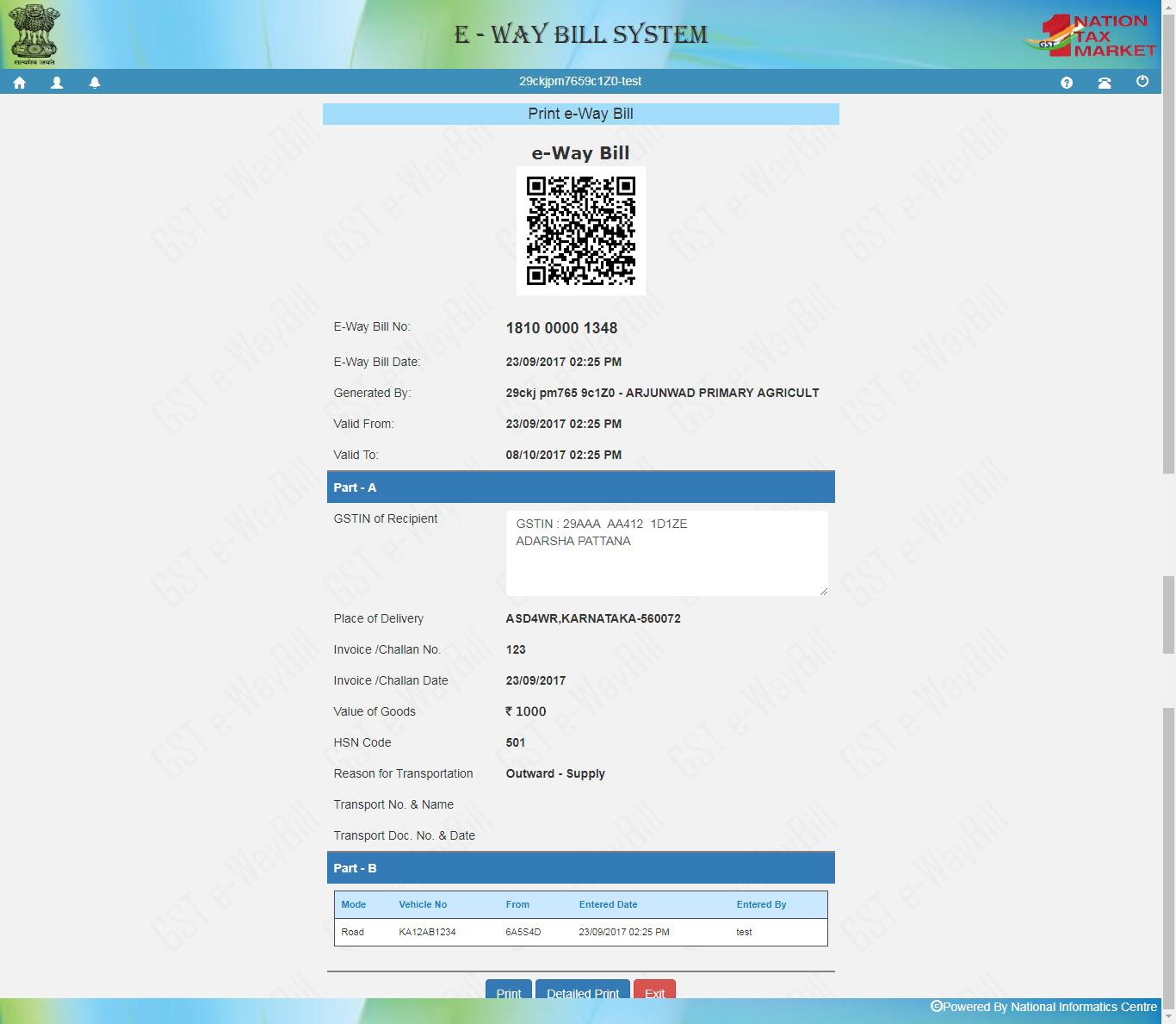
The e-way bill generated looks like this:
E-way bill
Print and carry the e-way bill for transporting the goods in the selected mode of transport and the selected conveyance.
You can print the e-way bill anytime as follows:
Step-1: Click on ‘Print EWB’ sub-option under ‘e-Waybill’ option
E-way bill
Step-2: Enter the relevant e-way bill number -12 digit number and click on ‘Go’
E-way bill
Step-3: Click on ‘Print’ or ‘detailed print’ button on the EWB that appears:
E-way bill


Hope the article helps. 

Thank you!  

Sunday, January 7, 2018

Reunion with my love.

It's been 6 months since I last wrote my last blog. I have been missing it badly. But life was so busy that I hardly found anytime to write. Every night when I used to retire for bed, a thought of my blog would always come to me. Lot many topics, ideas, discussions came to my mind...but none could reach my laptop ( or mobile). So much was my occupation in the past 6 months! It was something i was missing dearly. I have realised  writing is not only my hobby, it is natural refreshment for me.  I may be so much expressive  with my speech or expressions, but i feel so  light when i write it out. Now I am back, back to my love of writing. Hope to connect with my readers again! Happy to be back again! 


Friday, July 7, 2017

Information required for Transfer of Stock to GST


After Registration in GST, the next step is of stock transfer.  The rules have been notified by the government. Please refer to my blog http://mannkiabhivyakti.blogspot.in/2017/06/gst-transition-provisions-final-rules.html for detailed analysis of rules.  

But what all information would be required to transfer your stock to GST?  I have tried to compile the information which is useful for both business houses and practitioners.

Form GST TRAN - 1

Basic Information -

1. GSTIN -
2. Legal name of the registered person -
3. Trade Name, if any -
4. Whether all the returns required under existing law for the period of six months immediately preceding the appointed date have been furnished:- Yes/No

IAmount of tax credit carried forward in the return filed under existing laws:

a) Amount of Cenvat credit carried forward to electronic credit ledger as central tax (Section 140(1) and Section 140(4)(a))

1. Registration no. under existing law (Central Excise and Service Tax)
2. Tax period to which the last return filed under the existing law pertains
3. Tax period to which the last return filed under the existing law pertains
4. Balance cenvat credit carried forward in the said last return
5. Cenvat Credit admissible as ITC of central tax in accordance with transitional provisions

(b) Details of statutory forms received for which credit is being carried forward
      Period: 1st Apr 2015 to 30th June 2017

C Form , F Form, H/I form - 
1. TIN of issuer
2. Name of issuer
3. Sr.no. of form
4. Amount
5. Applicable VAT rate

(c) Amount of tax credit carried forward to electronic credit ledger as State/UT Tax(For all registrations on the same PAN and in the same State)

1. registration No. in existing law
2. Balance of ITC of VAT and [Entry Tax] in last return
3. C form, F Form, H/I form - Turnover for which forms Pending, 

II. Details of capitals goods for which unavailed credit has not been carried forward under existing law (section140 (2)).

a) Amount of unavailed cenvat credit in respect of capital goods carried forward to electronic credit ledger as central tax

1. Invoice / Document no.
2. Invoice / document Date
3. Supplier’s registration no. under existing law
4. Recipients’ registration no. under existing law
5. Details of capital goods on which credit has been partially availed - Value and Duties and taxes paid- ED/CVD and SAD
6. Total eligible cenvat credit under existing law
7. Total cenvat credit availed under existing law

b) Amount of unavailed input tax credit carried forward to electronic credit ledger as State/UT tax (For all registrations on the same PAN and in the same State)

1. Invoice / Document no.
2. Invoice / document Date
3. Supplier’s registration no. under existing law
4. Recipients’ registration no. under existing law
5. Details regarding capital goods on which credit is not availed - Value and Taxes paid VAT [and ET]
6. Total eligible VAT [and ET] credit under existing law
7. Total VAT [and ET] credit availed under existing law

III. Details of the inputs held in stock in terms of sections 140(3), 140(4)(b) and 140(6).

a) Amount of duties and taxes on inputs claimed as credit excluding the credit claimed under Table 5(a) and 7(a)

1. Details of inputs held in stock or inputs contained in semi-finished or finished goods held in stock -

i) HSN (at 6 digit level)
ii) Unit
iii) Quantity
iv) Value
v) Eligible Duties paid on such inputs

2. 7A Where duty paid invoices or any other document are available -

i) Inputs
ii) Inputs contained in semi-finished and finished goods

3. Where duty paid invoices are not available (Applicable only for person other than manufacturer or service provider) – Credit in terms of Rule 1 (4)

i) Inputs

b) Amount of vat and entry Tax paid on inputs supported by invoices/documents evidencing payment of tax carried forward to electronic credit ledger as SGST/UTGST 

1. Details of inputs in stock - Description, Unit,Quantity, Value, VAT [and Entry Tax] paid
2. Total input tax credit claimed under earlier law
3. Total input tax credit related to exempt sales not claimed under earlier law
4. Total Input tax credit admissible as SGST/UTGST
5. Same details are to be filed for Inputs contained in semi finished and finished goods 

c) Stock of goods not supported by invoices/documents evidencing payment of tax (credit in terms of rule 1 (4)) (To be there only in States having VAT at single point)

1. Details of inputs in stock - Description, Unit,Quantity, Value, Tax paid

IV. Details of transfer of cenvat credit for registered person having centralized registration under existing law (Section 140(8))

1. Registration no. under existing law (Centralized)
2. Tax period to which the last return filed under the existing law pertains
3. Date of filing of the return
4. Balance eligible cenvat credit carried forward in the said last return
5. GSTIN of receivers (same PAN) of ITC of CENTRAL TAX
6. Distribution document /invoice - Number and Date
7. ITC of CENTRAL TAX transferred

V. Details of goods sent to job-worker and held in his stock on behalf of principal under section 141

a) Details of goods sent as principal to the job worker under section 141

1. GSTIN of Job Worker, if available
2. Challan No.
3. Challan date
4. Type of goods (inputs/ semi-finished/ finished)
5. Details of goods with job- worker - HSN, Description, Unit, Quantity and value

b) Details of goods held in stock as job worker on behalf of the principal under section 141

1. GSTIN of Manufacturer
2. Challan No.
3. Challan date
4. Type of goods (inputs/ semi-finished/ finished)
5. Details of goods with job- worker - HSN, Description, Unit, Quantity and Value


VI. Details of goods held in stock as agent on behalf of the principal under section 142 (14) of the SGST Act
a) Details of goods held as agent on behalf of the principal

1. GSTIN of Principal
2. Details of goods with Agent - HSN, Description, Unit, Quantity, Value and Input Tax to be taken

b) Details of goods held by the agent

1. GSTIN of Principal
2. Details of goods with Agent - HSN, Description, Unit, Quantity, Value and Input Tax to be taken

VII. Details of credit availed in terms of Section 142 (11 (c ))

1. Registration No of VAT
2. Service Tax Registration No.
3. Invoice/document no.
4. Invoice/ document date
5. Tax Paid
6. VAT paid Taken as SGST Credit or Service Tax paid as Central Tax Credit

VIII. Details of goods sent on approval basis six months prior to the appointed day (section 142(12))

1. Document no.
2. Document date
3. GSTIN no. of recipient (If applicable)
4. Name & address of recipient
5. Details of goods sent on approval basis - HSN, Description, Unit, Quantity and Value

Form GSTR TRAN - 2

Basic Information -

1. GSTIN -
2. Name of Taxable Person
3. Tax Period - Month and Year

I. Details of inputs held on stock on appointment date in respect of which he is not in possession of any invoice/document evidencing payment of tax carried forward to Electronic Credit ledger.

1. Opening stock for the tax period - HSN (at 6 digit level), Unit, and Quantity
2. Outward supply made - Value, Central Tax, Integrated Tax and ITC allowed
3. Closing Balance - Quantity

II. Credit on State Tax on the stock mentioned in 4 above (To be there only in States having VAT at single point)

1. Opening stock for the tax period - HSN (at 6 digit level), Unit, and Quantity
2. Outward supply made - Value, Central Tax, Integrated Tax and ITC allowed
3. Closing Balance - Quantity


Thank You


Friday, June 23, 2017

A to Z of Composition Scheme in GST


The GST brings with itself a lot of compliances to be observed. It, in turn, increases the cost of compliance in the form of blocked working capital, additional manpower requirement etc. Big business houses can afford an extra cost. What about Small and Medium Enterprises (SME)? They neither have resources nor will to adhere to strict compliance requirement of GST.  In order to provide relief to small businessmen, CGST Act, 2017 provides for Composition Scheme. Let us first look at its advantages and disadvantages before moving on to the regulatory provisions.

Advantages of opting Composition Scheme:

1.      Limited Compliance

·        One Quarterly return as compared to  3 monthly returns under normal scheme ( see ‘Returns’ section below)
·        No need to maintain detailed books of accounts. Only information about Turnover in state, Inward Supplies, Tax Payable and Tax paid has to be maintained. ( see ‘Books of Accounts’ section below)
·        Do not require audit of accounts to be done unlike in normal cases. ( see ‘Audit’ section below)

2.      Reduced tax burden ( see ‘Tax Liability’ section below)

3.      High Liquidity – Under composition scheme, the registered person has to pay tax on turnover on quarterly basis only. Thus a substantial amount of working capital would be available to be circulated in business.

4.      Optional – Composition scheme is an optional one. A person may choose to register as normal taxpayer if he wish to do so.  
Disadvantages of opting Composition Scheme:
1.      Potential loss of business – Since the person opting for composition scheme cannot issue a tax invoice, hence, the purchaser of goods or recipient of service will not be eligible to claim ITC on such purchases. It may act as a deterrent to existing or future customers to purchase from such supplier and thus may lead to loss of business.

2.      No ITC – The person opting for composition scheme cannot claim ITC on its purchases.

3.      Cash Outflow – The person opting for composition scheme cannot charge tax (GST) from its customers and hence they have to pay taxes from their own pocket.
Regulatory Provisions

A.    Applicability

·        Registered Person
·        Aggregate Turnover (TO) in the preceding FY do not exceed Rs 75 Lakhs

B.     Eligibility

·        Registered person is not engaged in inter- state supply of goods (See Note 3 below)
·        he is not engaged in the supply of services other than supplies referred to in clause (b) of paragraph 6 of Schedule II ( See Note 1 below)
·        he is not engaged in making any supply of goods which are not leviable to tax under GST Act
·        he is not engaged in making any supply of goods through an electronic commerce operator who is required to collect tax at source under section 52 of CGST Act, 2017
·        he is not a manufacturer of such goods as may be notified by the Government on the recommendations of the Council
·        he should neither be a casual taxable person nor a non-resident taxable person
·        the goods held in stock by him on the appointed day have not been purchased in the course of inter-State trade or commerce or imported from a place outside India or received from his branch situated outside the State or from his agent or principal outside the State ( See Note 2 below)
·        the goods held in stock by him have not been purchased from an unregistered supplier and where purchased, he pays the tax under sub-section (4) of section 9 (i.e. reverse charge)
·        he shall mention the words “composition taxable person, not eligible to collect tax on supplies” at the top of the bill of supply issued by him
·        he shall mention the words “composition taxable person” on every notice or signboard displayed at a prominent place at his principal place of business and at every additional place or places of business
Note :
1.      Service under clause (b) of Schedule II is –
“supply, by way of or as part of any service or in any other manner whatsoever, of goods, being food or any other article for human consumption or any drink (other than alcoholic liquor for human consumption), where such supply or service is for cash, deferred payment or other valuable consideration.”
It implies that Composition scheme is available for Restaurant service provider only. It is also applicable for the restaurant services provided by the hotels.
2.      This clause is applicable to the person who is registered under current law and has opted for composition scheme under GST. There should not be a stock in hand as on 1st July which has been purchased from outside the state. So it is advisable to sell such stock before registering in GST as composite supplier. The restriction is only for stock in hands as on 1st July and not on fresh purchases.

3.      There is restriction on Inter – state Supply and not purchase after opting for composition scheme in GST. One can still purchase from outside the state after opting for composition scheme in GST.

4.      The registered person opting for composition scheme may not file a fresh intimation every year and he may continue to pay tax under the said section subject to the provisions of the Act and these rules.

C.    Registration

a)     Migration to GST

·        File intimation electronically, in FORM GST CMP 01 , duly signed or verified through electronic verification code (EVC), on the Common Portal, either directly or through a Facilitation Centre notified by the Commissioner, before 1st July
·        The intimation should be filed not later than 30 days from 1st July.
·        If the intimation is filed after 1st July the registered person shall not collect any tax from the appointed day but shall issue bill of supply for supplies made after the said day. 
·        Any person who applies for registration under this rule may give an option to pay tax under section 10 (Composition Scheme) in Part B of FORM GST REG-01, which shall be considered as intimation to pay tax under the said section.
·        Furnish the details of stock, including the inward supply of goods received from unregistered persons, held by him on the day preceding the date from which he opts to pay tax under the said section, electronically, in FORM GST CMP-03, on the Common Portal, either directly or through a Facilitation Centre notified by the Commissioner, within sixty days of the date from which the option for composition levy is exercised or within such further period as may be extended by the Commissioner in this behalf.
·        Any intimation under this rule in respect of any place of business in any State or Union territory shall be deemed to be intimation in respect of all other places of business registered on the same PAN. 


b)     New Registration under GST

·        File intimation electronically,  in FROM GST CMP 02 duly signed or verified through electronic verification code (EVC), on the Common Portal, either directly or through a Facilitation Centre notified by the Commissioner prior to the commencement of the financial year for which the option to pay tax under the aforesaid section is exercised.
·        File a statement in FORM GST ITC 3 within sixty days from the commencement of the relevant financial year.
·        Any intimation under this rule in respect of any place of business in any State or Union territory shall be deemed to be an intimation in respect of all other places of business registered on the same PAN. 

D.    Tax Liability

·        Manufacturer (other than manufacturer of notified goods) – 2% of turnover
·        Suppliers (food or any other article for human consumption or drinks ( other than alcoholic liquor for human consumption) – 5% of turnover
·        Other supplies (i.e. Dealer, trader or retailer of goods) – 1% of turnover

E.     Returns

·        The taxable person is required to furnish only one return i.e. GSTR-4 on a quarterly basis and an annual return in FORM GSTR-9A.

F.     Invoice

·        Person opting for composition scheme cannot issue a tax invoice. Instead he has to issue a Bill of Supply.
·        The Bill of Supply should mention the following details:

a)      name, address and GSTIN of the supplier
b)     a consecutive serial number not exceeding sixteen characters, in one or more multiple series, containing alphabets or numerals or special characters -hyphen or dash and slash symbolised as  “-” and “/”respectively, and any combination thereof, unique for a financial year;
c)      date of its issue
d)     name, address and GSTIN or UIN, if registered, of the recipient
e)      HSN Code of goods or Accounting Code for services
f)      description of goods or services or both
g)     value of supply of goods or services or both taking into account discount or abatement, if any
h)     signature or digital signature of the supplier or his authorized representative

G.    Books of Accounts

·        There is no need to maintain detailed books of accounts. Only the details of Purchase, sale and bills of supply need to be maintained.

H.    Audit 

·        Not applicable to person opting for composition scheme.

I.      Mode of Payment of Tax

·        Internet Banking through authorized banks
·        Credit card or Debit card through the authorised bank
·        National Electronic Fund Transfer (NEFT) or Real Time Gross Settlement (RTGS) from any bank
·        Over the Counter payment (OTC) through authorized banks for deposits up to ten thousand rupees per challan per tax period, by cash, cheque or demand draft

Thanks
c